Red Moon Guide: Understanding the Blood Moon Phenomenon
Delve into the captivating world of lunar eclipses and the mesmerizing Red Moon! This guide unveils the science, history, and observation techniques for this otherworldly spectacle.
What is a Red Moon?
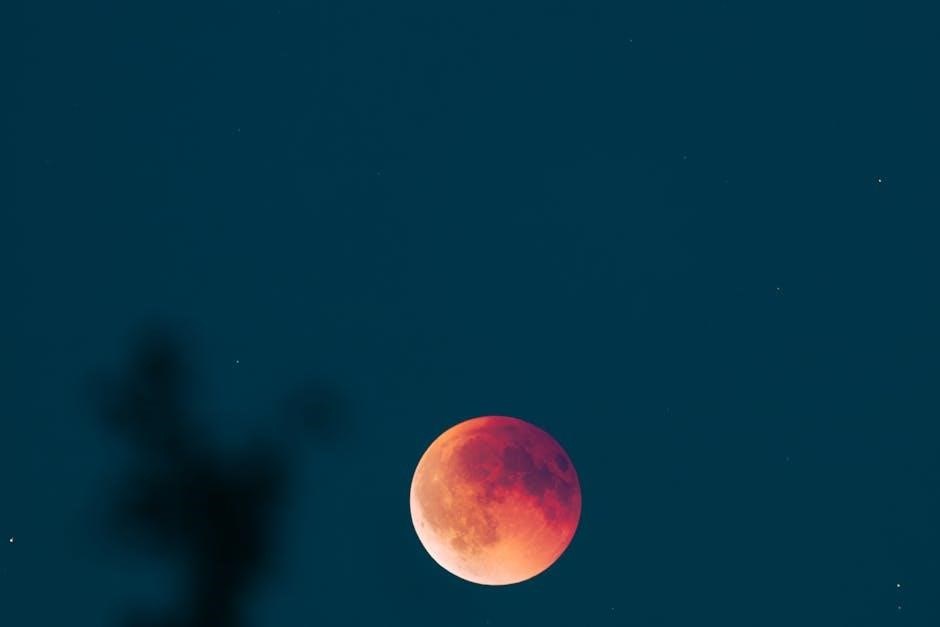
The Red Moon, often called a Blood Moon, is a breathtaking celestial event where the Moon appears to transform into a deep crimson or coppery color. This isn’t a typical lunar phase, but rather a visual effect occurring during a total lunar eclipse. It feels almost otherworldly when people gaze upon this rare sight, sparking curiosity and wonder.
Unlike a typical full moon’s bright, silvery glow, the Red Moon presents a dramatically different appearance. The intensity of the red hue can vary, ranging from a bright orange-red to a dark, dusky shade. This captivating phenomenon has captured the human imagination for centuries, inspiring myths, folklore, and cultural significance across diverse societies. It’s a truly remarkable spectacle that connects us to the cosmos.
The Science Behind the Red Hue
The reddish coloration of a Red Moon isn’t due to the Moon itself changing, but rather a result of how Earth’s atmosphere interacts with sunlight during a lunar eclipse. When the Moon passes entirely into Earth’s umbra – its darkest shadow – direct sunlight is blocked. However, some sunlight still reaches the lunar surface, but it’s been filtered and refracted through our planet’s atmosphere.
This atmospheric filtering is key. Shorter wavelengths of light, like blue and violet, are scattered away, while longer wavelengths, such as red and orange, are bent towards the Moon. This process, similar to why sunsets appear red, bathes the lunar surface in a reddish glow. The amount of dust and particles in Earth’s atmosphere also influences the intensity and shade of the red color.
Lunar Eclipses: The Primary Cause
Red Moons, or Blood Moons, are fundamentally linked to lunar eclipses, a spectacular celestial alignment where the Earth passes between the Sun and the Moon, casting a shadow upon the lunar surface. This event can only occur during a full moon, when the Moon is positioned opposite the Sun in the sky. The type of lunar eclipse dictates the appearance and intensity of the red hue.
While any lunar eclipse can result in a reddish tint, total lunar eclipses typically produce the most dramatic and vibrant Red Moon displays. However, partial and even penumbral eclipses can contribute to a subtle color change. Understanding the mechanics of these eclipses is crucial to grasping why and when we witness this captivating phenomenon, a blushing Moon in the night sky.
Types of Lunar Eclipses
Lunar eclipses aren’t all created equal; they fall into three distinct categories, each offering a unique visual experience. Total Lunar Eclipses occur when the entire Moon passes into the Earth’s umbra – the darkest part of its shadow – resulting in a complete, often reddish, lunar covering. Partial Lunar Eclipses happen when only a portion of the Moon enters the umbra, creating a dark shadow across a segment of the lunar disk.
Finally, Penumbral Lunar Eclipses are the most subtle, occurring when the Moon passes through the Earth’s penumbra – the outer, lighter part of its shadow. These often appear as a slight dimming of the Moon’s brightness, and the reddish hue is less pronounced, sometimes barely noticeable. The type of eclipse significantly influences the intensity and visibility of the Red Moon effect.
Total Lunar Eclipse
A Total Lunar Eclipse is arguably the most dramatic of all eclipse types, transforming the familiar lunar surface into a breathtaking spectacle of reddish hues. This occurs when the Moon fully enters the Earth’s umbra, the darkest part of our planet’s shadow. During totality, the Moon doesn’t disappear entirely; instead, it often takes on a copper or blood-red color, earning it the nickname “Blood Moon.”
The duration of totality can vary, lasting from a few minutes to over an hour, depending on the Moon’s path through the shadow. These events are visible from anywhere on Earth experiencing nighttime during the eclipse, making them widely accessible and captivating celestial events. Observing a total lunar eclipse is a truly unforgettable experience for astronomy enthusiasts and casual observers alike.
Partial Lunar Eclipse
A Partial Lunar Eclipse happens when only a portion of the Moon passes through the Earth’s umbral shadow. Unlike a total eclipse, the Moon doesn’t fully darken, instead displaying a noticeable dark shadow gradually covering a part of its surface. The shadowed area appears significantly dimmer than the rest of the lunar disk, creating a striking contrast.

The extent of the partial eclipse – how much of the Moon is covered – varies with each event. These eclipses are also widely visible from any location experiencing nighttime during the event, though the view isn’t as dramatic as a total eclipse. Partial eclipses offer a fascinating opportunity to observe the Earth’s shadow interacting with the lunar surface, providing a unique celestial display.
Penumbral Lunar Eclipse
A Penumbral Lunar Eclipse occurs when the Moon passes through the Earth’s penumbral shadow – the outer, fainter part of the shadow. This type of eclipse is often the most subtle, and can be quite difficult to notice. The Moon doesn’t typically turn a dramatic color, but may appear slightly dimmed or shaded, a subtle darkening of the lunar surface.
Because the penumbra is so diffuse, many penumbral eclipses go largely unnoticed by casual observers. Experienced skywatchers, however, can detect the slight shading, especially near the maximum point of the eclipse. These events are visible from a much wider area of Earth than total or partial eclipses, as the penumbral shadow is larger and less defined, offering a gentle celestial event.
Why Does the Moon Turn Red?
The captivating reddish hue of a Red Moon isn’t due to a change in the Moon itself, but rather how sunlight interacts with Earth’s atmosphere during a lunar eclipse. When the Moon moves into Earth’s shadow, direct sunlight is blocked, but some light still reaches the lunar surface – refracted, or bent, through our planet’s atmosphere.
This refracted light is filtered, with shorter wavelengths (blues and greens) scattered away. Longer wavelengths, like reds and oranges, are less affected and are bent towards the Moon, bathing it in a coppery glow. The intensity of the red color depends on the amount of dust and clouds present in Earth’s atmosphere at the time of the eclipse, creating a truly unique spectacle.
Rayleigh Scattering and the Earth’s Atmosphere
Rayleigh scattering, a phenomenon crucial to understanding the Red Moon, describes the scattering of electromagnetic radiation (like sunlight) by particles of a much smaller wavelength. In Earth’s atmosphere, these particles are primarily nitrogen and oxygen molecules.
Shorter wavelengths of light – blues and violets – are scattered more strongly than longer wavelengths, which is why our sky appears blue during the day. During a lunar eclipse, as sunlight passes through the Earth’s atmosphere, this scattering effect removes much of the blue light. The remaining light, predominantly red and orange, is refracted onto the Moon’s surface.
Essentially, Earth’s atmosphere acts like a lens, filtering and coloring the sunlight before it reaches the eclipsed Moon, creating the stunning crimson appearance.
The Role of Dust and Particles
Beyond Rayleigh scattering, the presence of dust and particles in Earth’s atmosphere significantly influences the intensity and shade of the Red Moon. Volcanic eruptions, wildfires, and even significant dust storms can inject substantial amounts of particulate matter into the upper atmosphere.
These particles further scatter and absorb shorter wavelengths of light, enhancing the red coloration. A greater concentration of dust typically results in a deeper, more blood-red hue. Conversely, a cleaner atmosphere allows more orange and yellow light to pass through, creating a brighter, copper-toned Moon.
Therefore, the appearance of a Red Moon isn’t solely determined by atmospheric gases but also by the ever-changing composition of airborne particles, making each eclipse uniquely beautiful.
Historical and Cultural Significance
Throughout history, the Red Moon has captivated and often frightened cultures worldwide, inspiring a wealth of mythology and folklore. Its dramatic appearance was frequently interpreted as an omen, often foretelling disaster, war, or the wrath of the gods.
Ancient civilizations meticulously recorded lunar eclipses, weaving them into their religious beliefs and cosmological understandings. The Moon’s transformation was seen as a symbolic death and rebirth, influencing rituals and prophecies.
Across diverse cultures, the Red Moon represented everything from divine anger to a warning of impending change. These interpretations demonstrate humanity’s enduring fascination with the cosmos and our attempts to find meaning in celestial events.
Red Moon in Mythology
Many mythologies associate the Red Moon with powerful deities and dramatic cosmic battles. In some traditions, the crimson hue signified the blood of gods spilled during celestial conflicts, or the anger of lunar goddesses.
Certain cultures believed a red-tinged Moon indicated a monstrous entity was attempting to devour it, prompting rituals to scare away the beast. Others saw it as a portal opening to the underworld, allowing spirits to roam freely.
The Incas, for example, believed a red Moon signaled the jaguar would attack, while some European folklore linked it to werewolves and other creatures of the night. These myths reflect humanity’s primal fears and attempts to explain the extraordinary.
Red Moon in Folklore
Across numerous cultures, folklore paints the Red Moon as an omen, often foretelling misfortune or significant change. Traditional beliefs frequently linked the phenomenon to impending war, famine, or the death of a ruler, inspiring widespread anxiety and precautionary measures.
Many rural communities practiced specific rituals during a Blood Moon, such as staying indoors, covering mirrors, or making offerings to appease potentially angered spirits. Stories circulated of livestock behaving erratically, and crops failing to thrive under the crimson glow.
Some folklore suggests the Red Moon heightened magical abilities, making it a potent time for spellcasting – both benevolent and malevolent. These tales demonstrate how ancient societies interpreted celestial events through the lens of their everyday lives and anxieties.
Red Moon in Different Cultures
The interpretation of a Red Moon varies dramatically across global cultures, reflecting unique cosmologies and belief systems. In some Indigenous American traditions, a Blood Moon signifies a time of powerful spiritual energy, demanding introspection and ceremonial practices to maintain balance.
Conversely, in parts of Asia, a Red Moon historically symbolized impending disaster, prompting rulers to issue warnings and prepare for potential calamities. Mesopotamian cultures associated the phenomenon with the wrath of the gods, requiring appeasement rituals.
European folklore often connected the Red Moon to vampires and werewolves, fueling tales of nocturnal creatures gaining strength under its eerie light. These diverse interpretations highlight humanity’s enduring fascination with, and often fearful respect for, celestial events.
Observing a Red Moon

Witnessing a Red Moon is a breathtaking experience, requiring minimal equipment but maximizing preparation for optimal viewing. The event unfolds gradually, so find a location with an unobstructed eastern horizon, away from bright city lights, for the clearest view.
Begin observing as the Moon enters the Earth’s penumbra – the outer, fainter part of the shadow – noticing a subtle dimming. The most dramatic color changes occur during totality, when the Moon is fully immersed in the umbra, the dark central part of the shadow.
Record your observations, noting the color intensity and any variations throughout the eclipse. Share your experience with fellow astronomy enthusiasts and contribute to citizen science projects documenting the event’s characteristics.

Safety Precautions for Viewing
Observing a Red Moon is perfectly safe for your eyes, unlike viewing a solar eclipse! You do not need any special filters or protective eyewear to gaze at the lunar spectacle. The Moon, even when deeply colored, emits only reflected sunlight, posing no risk of retinal damage.
However, prioritize general safety during your viewing experience. Choose a secure location, free from obstacles and potential hazards, especially when observing in the dark. Be mindful of your surroundings and avoid trespassing on private property.
If using binoculars or a telescope, ensure they are stable and properly set up to prevent accidental falls. Dress warmly, as nighttime temperatures can drop significantly. Enjoy the celestial show responsibly!
Best Equipment for Viewing
While a Red Moon is visible to the naked eye, certain equipment can significantly enhance your viewing experience. For a closer look at the lunar surface details and the subtle color variations, binoculars are an excellent starting point. A magnification of 7x to 10x provides a satisfying view without requiring a tripod for stability.
For more detailed observations, a telescope is ideal. Even a small telescope with a diameter of 60mm can reveal craters, mountains, and the overall texture of the Moon. Larger telescopes, naturally, offer even greater clarity and magnification.
Remember to allow your eyes to adjust to the darkness for at least 20 minutes for optimal viewing. A comfortable chair and a red-light flashlight (to preserve night vision) are also helpful accessories!

Binoculars
Binoculars offer a fantastic and accessible way to observe a Red Moon, bridging the gap between naked-eye viewing and the detail provided by a telescope. A magnification power of 7x to 10x is generally recommended, providing a comfortable balance between magnification and a wide field of view – crucial for locating and tracking the Moon.
Look for binoculars with an objective lens diameter of 50mm or larger to gather sufficient light, enhancing the brightness and clarity of the lunar surface. Porro prism binoculars generally offer better depth perception, while roof prism binoculars are more compact.
Stability is key; consider using a tripod adapter for extended viewing sessions to minimize shaking and enjoy sharper images of the crimson lunar landscape.
Telescopes
For the dedicated observer, a telescope unlocks incredible detail during a Red Moon event, revealing subtle shading and surface features. Reflecting telescopes (Newtonian or Cassegrain) are popular choices, offering large apertures for light gathering at a reasonable cost. Refracting telescopes provide excellent contrast and sharpness, ideal for lunar observation.
Aperture is paramount; larger apertures gather more light, resulting in brighter and more detailed views. Magnification is important, but excessive magnification can diminish image quality due to atmospheric turbulence.

Lunar filters can enhance contrast and reduce glare, making it easier to discern subtle variations in the Moon’s reddish hue. A sturdy tripod is essential for stable viewing, and equatorial mounts facilitate tracking the Moon’s movement across the sky.
Predicting Red Moon Events
Predicting a Red Moon requires understanding the orbital mechanics of the Earth, Moon, and Sun. Lunar eclipses, and therefore Red Moons, occur when the Earth passes directly between the Sun and Moon, casting its shadow upon the lunar surface. These events aren’t random; they follow predictable patterns based on the lunar cycle and the alignment of orbital planes.
Several websites and astronomical organizations provide accurate eclipse predictions years in advance. These predictions detail the eclipse type (total, partial, penumbral), the date and time of maximum eclipse, and the visibility from different locations on Earth.

Utilizing astronomical software or apps can also help pinpoint upcoming Red Moon events and their characteristics. Regularly checking these resources ensures you won’t miss a spectacular celestial display!
Upcoming Red Moon Dates (as of 12/13/2025)
Mark your calendars, astronomy enthusiasts! As of today, December 13, 2025, several opportunities to witness a Red Moon are on the horizon. While the exact visibility depends on your location, these dates offer promising chances for a spectacular show.
The most anticipated event is rapidly approaching: September 7, 2025. This eclipse promises a particularly vibrant, coppery-red hue as the Moon journeys through Earth’s shadow. Further ahead, predictions indicate potential partial lunar eclipses visible in certain regions on March 14, 2026, and August 6, 2026.
Remember to consult specialized astronomy websites for precise timings and visibility maps tailored to your specific geographic location. Don’t miss these breathtaking celestial events!
September 7, 2025 Eclipse Details
Prepare for a stunning celestial display on the night of September 7, 2025! This date marks a significant total lunar eclipse, widely anticipated for its dramatic “Blood Moon” appearance. The eclipse will begin with the penumbral phase, subtly dimming the Moon’s brightness, followed by the partial phase as Earth’s shadow creeps across its surface.
Totality – the period when the Moon is fully immersed in the umbra – is expected to last approximately one hour and fifteen minutes, offering ample time for observation and photography. During totality, the Moon will transform into a captivating copper-red color, a result of sunlight filtering through Earth’s atmosphere.
The eclipse will be visible across North and South America, with optimal viewing conditions expected along the Pacific coasts. Remember to check local timings for precise start and end times in your region!
Debunking Red Moon Myths
Throughout history, the Red Moon has inspired numerous myths and superstitions, often rooted in fear and misunderstanding. Many ancient cultures interpreted the Blood Moon as a bad omen, predicting disaster, war, or the wrath of the gods. These beliefs stemmed from the Moon’s unusual appearance and its association with nighttime and the unknown.
However, modern science provides a rational explanation for the phenomenon; The red hue is not a sign of impending doom, but a beautiful consequence of atmospheric optics. Contrary to some claims, looking at a Red Moon is entirely safe and poses no harm to your eyes – it’s simply a dimmed, reddish version of the familiar lunar glow.
Let’s embrace the Red Moon for its scientific wonder and historical significance, rather than succumbing to unfounded fears and ancient folklore!
Is it Harmful to Look at a Red Moon?
A common concern surrounding the Red Moon is whether viewing it poses any risk to your eyes. Fortunately, the answer is a resounding no! Unlike looking directly at the sun, which can cause severe and permanent damage, observing a lunar eclipse, even when the Moon appears red, is completely safe.
The red coloration is simply the result of sunlight being filtered and refracted through Earth’s atmosphere. This process significantly reduces the intensity of the light reaching your eyes, making it comparable to looking at a full moon on a clear night.
You do not need any special eye protection to enjoy this celestial event. Feel free to gaze upon the Blood Moon with the naked eye, binoculars, or a telescope without worry!
Resources for Further Learning
Embark on a deeper exploration of astronomy with these valuable resources! For beginners, several guidebooks offer accessible introductions to the cosmos. Stars: A Guide to the Constellations, a classic, provides detailed star charts and constellation lore, while more modern options like Nightwatch by Terence Dickinson offer updated information and observing tips.
Numerous online resources also cater to aspiring astronomers. Websites like NASA’s eclipse page (https://eclipse.gsfc.nasa.gov/) provide comprehensive data and predictions for upcoming eclipses. Space.com and EarthSky offer regularly updated articles, news, and stunning imagery of celestial events.
Don’t forget to explore astronomy forums and communities to connect with fellow enthusiasts and share your observations!
Beginner Astronomy Guidebooks
For those just starting their astronomical journey, a good guidebook is invaluable. Classics like Stars: A Guide to the Constellations, published decades ago, remain relevant for their detailed star charts and foundational knowledge. It’s a wonderful starting point for learning constellations and navigating the night sky.
More contemporary options offer updated information and observing techniques. Nightwatch by Terence Dickinson is a highly recommended resource, praised for its clear explanations and practical advice. Another excellent choice is Turn Left at Orion by Guy Consolmagno and Dan M. Davis, specifically geared towards those using small telescopes or binoculars.
These guidebooks provide a solid foundation for understanding celestial events like the Red Moon and beyond!
Online Astronomy Resources
The internet offers a wealth of information for aspiring astronomers. Websites like NASA’s Space Place (spaceplace.nasa.gov) provide accessible explanations of complex astronomical phenomena, including lunar eclipses and the Red Moon, geared towards all ages.
For more in-depth information and current event updates, Space.com (space.com) and EarthSky (earthsky.org) are excellent resources. These sites feature articles, news, and observing guides written by experts in the field. Timeanddate.com (timeanddate.com) is particularly useful for predicting eclipse visibility from your location.
Interactive simulations and apps, such as Stellarium (stellarium.org – a free planetarium software), can help you visualize the night sky and plan your Red Moon observations. These digital tools complement traditional guidebooks and enhance your understanding of the cosmos!
No Responses